The “tell me about a challenge” question, decoded
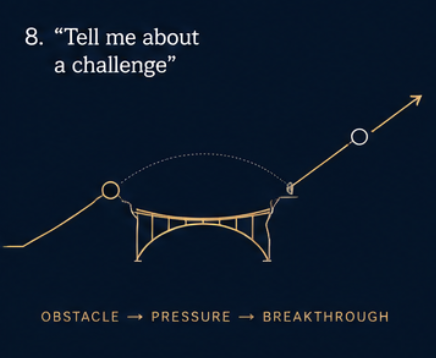
“Tell me about a challenge you’ve faced” is the most asked behavioral question in interviews, and the most misunderstood.
Most candidates hear “challenge” and reach for the most dramatic story they have. A team in crisis. A project on fire. A bad boss. The instinct is right — interviewers do want a real challenge. But they’re not actually evaluating the challenge itself. They’re evaluating three things you say about the challenge.
What’s actually being tested
Autonomy. Did you act, or did you wait for someone to tell you what to do? The interviewer wants to see that you don’t need supervision in hard moments.
Judgment. Did you choose the right intervention? Anyone can do something when things get hard. The question is whether you did the right thing for the situation.
Resilience. When the first thing didn’t work — and it never does — what did you do next? The interviewer is listening for a candidate who adapts, not one who claims they had a plan from the start.
The right size of challenge
Pick a challenge that’s a 4 out of 10, not a 10 out of 10.
Candidates instinctively pick their hardest story because they think hard = impressive. But a 10 out of 10 challenge (your company nearly went bankrupt, your team had a death, you were in a lawsuit) often comes with confounding factors. The interviewer can’t tell what was you and what was circumstance.
A 4 out of 10 challenge — a hard week on a stuck project, a difficult colleague, a deliverable that wasn’t going to land on time — is more useful. The size is small enough that the interviewer can see exactly which decisions you made.
The “actually did” trap
This is the single most common failure I see in coaching.
Candidates over-claim. “I rebuilt the team’s approach to client communication.” “I owned the response to the regulatory issue.” “I drove the turnaround of the project.”
Half the time, the interviewer is going to follow up with: “Tell me more about what you specifically did.” And if you can’t, because you actually didn’t, the answer collapses.
Better: own the slice you actually did. “I owned the first 48 hours of the response — specifically, I drafted the communication plan, ran two internal stakeholder calls, and got sign-off from legal on our external message.” That’s smaller than “I drove the turnaround.” It’s also true, and it gets you the offer.
How to frame a failed initiative as a win
Most candidates avoid stories where the outcome wasn’t great. That’s a mistake.
If you only have polished success stories, the interviewer suspects you’re either inexperienced or hiding something. The candidates who get hired have at least one story about something that didn’t fully work — and what they learned from it.
The frame:
- The stakes and the friction. Same as any behavioral story.
- What you tried that didn’t work. Be specific. Not “the team didn’t align” but “I tried to align the team in a single 90-minute meeting and it backfired — two people walked out frustrated and the rest got quiet.”
- What you tried next. “I went back and did one-on-ones with the four loudest skeptics over the next week, found the actual objection, and adjusted the proposal before we met again.”
- What changed. “The second meeting got us unstuck. The bigger lesson was that I’d skipped the political work upfront, which would’ve avoided the first failure entirely. I haven’t repeated that pattern since.”
The fourth piece is what makes the failure a strength. You don’t just tell the story — you tell what you learned and how you’ve applied it since.
Two real examples
A tech candidate, applied to a senior PM role:
“Mid-2023, we were launching a major redesign of the checkout flow on six weeks of runway. Two weeks in, our user research showed the new design was actually performing worse than the current one on the segment that drove 70% of revenue.
The challenge wasn’t the data — it was that I’d already gotten executive buy-in for the launch. Pulling back would’ve cost me credibility.
I took 48 hours to design three alternatives, then went to my VP with the data and a recommendation to delay by three weeks to test a hybrid approach. I owned the conversation, including telling her I’d been wrong to assume the previous research was sufficient.
We delayed, ran the test, shipped the hybrid version, and ended up improving checkout conversion by 12% instead of the projected 4%. The real outcome wasn’t the lift — it was that my VP brought me back into bigger decisions after that meeting, because I’d been honest about being wrong.”
A finance candidate, applied to a principal role:
“Last year I was leading underwriting on a $200M deal that I’d been pushing internally for four months. Two weeks before close, our diligence team found a structural risk on the customer concentration side that I hadn’t priced in.
The challenge was political. I’d advocated hard for the deal. Walking it back was going to make me look wrong.
I spent a weekend re-running the model with the new risk priced in. The returns dropped from 22% IRR to 14%. I went to my MD on Monday with the new analysis and recommended we pass.
We did. Three months later, that same customer concentration risk hit one of the deal’s competitors hard, and the company we’d been about to buy lost 30% of its revenue. The deal would’ve been a disaster.
The lesson wasn’t ‘I was right to pass.’ It was that I should’ve pressured-tested customer concentration earlier in the process, before I’d already advocated for the deal publicly. I changed how I run diligence after that.”
What to skip
- Don’t pick a challenge with a famous bad-actor in it. Stories where “my boss was the problem” make the candidate sound like they can’t navigate conflict.
- Don’t pick a challenge that the interviewer can’t relate to. Niche industry stuff with no analog elsewhere goes over their head.
- Don’t claim you saved the day single-handedly. Senior interviewers know nothing important gets done alone.
Try this
Pick a moderate-difficulty challenge — a 4 out of 10. Write the story in four lines:
- The stakes and the friction.
- What I specifically did. (Not what “we” did.)
- What didn’t work the first time.
- What I’d do differently now.
If line three says “everything went smoothly,” pick a different story.
If your behavioral answers feel either generic or over-claimed when you read them out loud, that’s worth fixing before the real thing. Free 15-minute consult: book here.
More on building real behavioral stories: mock interview coaching. Free 25-questions guide: download here.
Free guide
The 25 interview questions you must prepare.
The starter list I use with every coaching client. Finance, consulting, tech, MBA, medical, residency. Different industries, same underlying questions.
Or book a free 15-minute consultation with Neil.