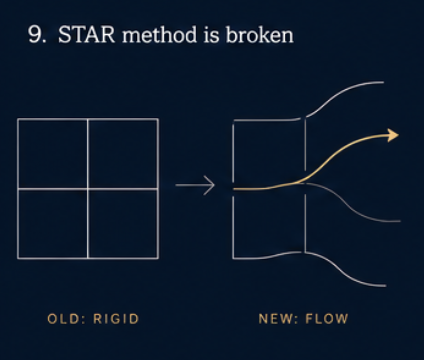
The STAR method is broken. Here’s what works instead.
If you’ve prepped for an interview in the last 10 years, you’ve heard of STAR. Situation, Task, Action, Result. It’s in every career book, every YouTube prep video, every university career services PDF.
It produces robotic answers.
I’ve sat through hundreds of mock interviews where a candidate dutifully marches through Situation, Task, Action, Result — and the interviewer (in my coaching seat) is fighting to stay engaged. The framework is so widely taught that experienced interviewers can spot it in three sentences. And when they spot it, they stop listening for content and start counting filler words.
Here’s a better framework. Same four parts, different priorities, much harder to spot.
The new framework: Stakes → Friction → Action → What Changed
Stakes first. Forget “Situation.” Don’t open with the boring scaffolding (“So in my last role we had a project where…”). Open with what was at stake.
“We were six weeks from launch on the biggest contract in company history — a deal that represented 40% of next year’s revenue — and the lead developer just quit.”
That’s stakes. Now the interviewer is leaning in.
Friction. Not “Task.” Tasks are boring. Friction is the thing that made the situation hard. The thing that made it not-a-plan.
“The contract was structured so a missed launch date wasn’t just a delay — it triggered a $2M penalty clause. And our backup engineer had no context on the codebase.”
Now they’re really listening.
Action — but only what you did. This is where most candidates over-claim. “We rebuilt the team.” “We pivoted the approach.” Hiring managers can’t evaluate “we.” They can only evaluate “I.”
“I sat down with the backup engineer for the first 48 hours and walked him through the architecture decisions, including the dumb ones. I then re-scoped the launch to a phased rollout — the contract didn’t actually require everything at once, even though we’d been treating it that way. I negotiated the phasing with the client over a one-hour call where I had to explain why this was better for them, not worse.”
Specific. First person. Concrete decisions.
What Changed. Not “Result.” Results sound like a press release. “What Changed” tells you what was different because of the action.
“We hit phase one on time, took zero penalty, and the client renewed at 1.4x the original contract size the following year. The phased structure became how we handled every enterprise launch after.”
Two key differences: first person, and the change extends past the immediate outcome — a second-order effect where phased structure became standard.
Why this works better
Three things.
Stakes-first hooks the interviewer. When the opening sentence has tension in it, the listener leans in. When the opening sentence is “So I was at my last job and there was a project…” the listener tunes out before you’ve finished setup.
Friction makes the story matter. Stories without friction are reports. Stories with friction are stories.
“What changed” is more honest than “result.” Anyone can fabricate a number. (“We grew revenue 40%.”) But describing what changed — a process, a relationship, a way of operating — is harder to fake, and lands as more true.
Same story, both ways
STAR version:
“Situation: I was working on a large client contract that was at risk. Task: I needed to ensure we delivered on time. Action: I collaborated with the team to re-scope the project and communicated with the client. Result: We hit the deadline and the client renewed.”
Eight seconds in, the interviewer is checking their watch.
New version:
“Six weeks before launch on a $4M contract, our lead developer quit. The contract had a $2M penalty clause if we missed the deadline. I spent 48 hours bringing the backup engineer up to speed, then re-scoped the launch as a phased rollout and went back to the client to sell them on the new structure. We hit phase one, took zero penalty, and they renewed at 1.4x the next year. We made phased structure the default for every enterprise launch after that.”
Same content. Completely different listening experience.
What to do with your existing STAR answers
You probably have four or five STAR answers prepped for the standard behavioral questions. Don’t throw them out. Re-edit them.
For each one:
- Cut the situational scaffolding. Replace “So in my last role…” with the stakes.
- Find the friction. What was the actual hard part? Lead with it.
- Rewrite Action in first person, specific. Cut every “we” that should be “I.”
- Re-frame Result as What Changed. What’s different now? Both immediately and downstream?
Each rewrite takes ~10 minutes. Five answers, one hour. You’ll feel the difference the first time you read one aloud.
Try this
Pick one of your prepped behavioral stories. Rewrite the opening line so it leads with stakes, not setup. Don’t use the word “situation” or “task.” Just open on the tension.
If your new opener doesn’t make a listener lean forward, you haven’t found the stakes yet. Keep rewriting until it does.
If your behavioral answers feel formulaic when you read them aloud, that’s worth fixing before your next interview. Free 15-minute consult: book here.
More on building interview-ready stories: mock interview coaching. Free 25-questions guide: download here.
Free guide
The 25 interview questions you must prepare.
The starter list I use with every coaching client. Finance, consulting, tech, MBA, medical, residency. Different industries, same underlying questions.
Or book a free 15-minute consultation with Neil.