“What’s your biggest weakness?” — the answer that doesn’t sound rehearsed
There are two bad answers to “what’s your biggest weakness,” and 90% of candidates pick one of them.
The humblebrag. “I’m too detail-oriented.” “I work too hard.” “I care too much about quality.” Interviewers stopped buying this in 1998. It now tells them one thing — that you’re not self-aware.
The contrived weakness. “I sometimes have trouble delegating.” “I’m a perfectionist.” “I struggle with work-life balance.” Slightly better, but most candidates can’t say it without sounding like they read it on a Glassdoor thread an hour ago. Because they did.
Why the question exists
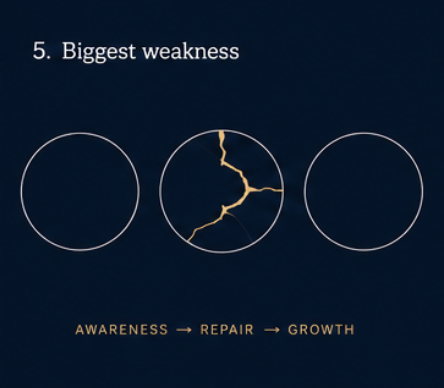
Interviewers don’t actually care about your weakness. They care about three things, in this order:
- Can you name a real one without panicking?
- Are you doing something about it?
- Has the thing you did actually worked?
That’s it. The question is a triple-check on self-awareness, accountability, and improvement. Not a confession booth.
The formula
Three parts, 60 seconds total.
Name the weakness, specifically. Not “I’m not great at communication.” Try “I used to over-explain in meetings — when I was nervous about a recommendation, I’d pad it with three minutes of context nobody needed.”
The detail does the work. A specific weakness sounds true. A vague one sounds rehearsed.
Name what you’ve changed. “I now write a one-line summary of any recommendation before I walk into the meeting, and I commit to leading with that line. If I have backup context, it comes after, only if asked.”
The system matters more than the awareness. Anyone can identify a weakness. The candidates who get hired did something about it.
Name how you know it’s working. “Six months in, my last review specifically called out that I drive meetings more crisply. My manager mentioned it twice.”
External validation closes the loop. It tells the interviewer you didn’t just decide you fixed it — someone else noticed.
Two examples that work
Tech / product role:
“I used to ship features before I’d fully validated the problem. Early in my career I’d push a build live, get one customer email saying ‘this is great,’ and assume we’d nailed it. We hadn’t. We were getting positive feedback from the loudest 5% of users and silence from everyone else.
About a year ago I started running a structured discovery process before any feature gets prioritized — at least five customer interviews, two of which have to be people who haven’t used the product yet. It’s slower upfront. But our last three feature launches actually moved retention metrics, which the previous three didn’t.”
Finance role:
“I used to under-prepare for client meetings. I’d lean on my technical knowledge and assume I could think on my feet about the company. With sophisticated clients, that’s not enough.
Now I block 90 minutes before every client meeting to write a one-page brief — what they’re worried about, what’s in the news on their portfolio companies, what my recommendation is, and the two pushbacks I’d expect. I read it on the way over. My principal noticed after the third meeting and said it was the difference between feeling like an analyst and feeling like a partner-in-training.”
What not to do
Don’t pick something that disqualifies you from the role. “I’m bad at math” in a finance interview is not “honest” — it’s a mistake.
Don’t pick something obvious from your resume. If you’re applying to a role that requires Excel and you’ve never used it, you don’t get to pick “still learning Excel” as your weakness. They already know.
Don’t make it about a personal attribute. “I can be impatient.” “I’m shy in group settings.” Personality traits are unfixable in a 60-second answer. Pick a skill or habit. Those have actionable improvement stories.
Try this now
Pick a real weakness — one your last manager or close coworker would actually identify if asked. Write three sentences:
- Name it specifically. Use a concrete example.
- Name the system you put in place to fix it.
- Name the external proof that it’s working.
If sentence three doesn’t exist yet, that’s a different problem — your weakness isn’t actually being worked on, and the interviewer will sense it. Pick a different one, or actually start working on this one.
If your weakness answer feels rehearsed when you read it out loud, that’s worth fixing before your next interview. Free 15-minute consult: book here.
The 25 questions you should prep before any interview: download the guide. Full one-on-one prep: interview coaching.
Free guide
The 25 interview questions you must prepare.
The starter list I use with every coaching client. Finance, consulting, tech, MBA, medical, residency. Different industries, same underlying questions.
Or book a free 15-minute consultation with Neil.