“Why this firm?” — the answer template, with two examples
“Why our firm?” is the easiest interview question to nail and the easiest one to blow.
It’s easy to nail because the answer is researchable. The interviewer is handing you 60 seconds to demonstrate that you actually want this specific job — and that you’ve done your homework.
It’s easy to blow because most candidates give one of three terrible answers:
- The flattery answer. “Your firm is a leader in the industry and I’d love to learn from the best.” Says nothing. Could apply to any firm.
- The growth answer. “I want to grow my career and your firm is a great place to do that.” Says less than nothing.
- The brand-name answer. “You’re a top firm and the prestige would be a great next step.” Honest, sometimes. Also disqualifying.
What the question is actually testing
Three things, in this order:
- Did you do your research?
- Do you understand what’s specific about this firm vs. competitors?
- Is the reason you want to work here connected to who you actually are?
That third one matters most. The interviewer isn’t trying to confirm you’ve read their About page. They’re trying to figure out if you’d stay for three years instead of one.
The two-part template
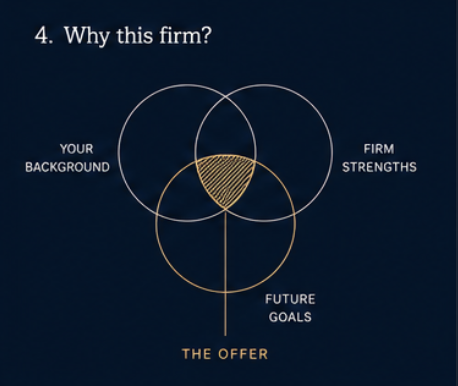
Part one — what’s specific about the firm. One sentence naming something concrete that this firm does differently than its closest competitors.
Not “your firm is innovative.” Try “Your team has been building out the credit-fund-of-funds practice in a way that I haven’t seen at your closest peers — it’s leaner, more thesis-driven, and you’ve published research on energy transition that I’ve actually been citing in my current role.”
The specificity is what does the work. You’re proving you’ve read the actual output of the firm, not just the careers page.
Part two — why that connects to who you are. One sentence naming a piece of your background that maps directly to what you just said about the firm.
Try “I’ve spent the last three years working on energy infrastructure financing in a more diversified shop, and the chance to specialize in the transition thesis specifically — with a team that’s building infrastructure around that thesis — is the next obvious move for me.”
You’re not asking them to take you on faith. You’re connecting two specific dots: a specific thing about them, and a specific thing about you.
Example 1 — applying to a strategy consulting role
“What I noticed in your last two case studies — the one on grocery digital transformation and the one on regional bank cost takeout — is that your team goes deeper into client implementation than the typical strategy firm. You don’t hand off a 200-page deck and disappear. The case study showed a 14-month engagement where your team was still on-site at month 12.
That matters to me because the part of consulting I love isn’t the analysis — it’s watching the recommendation actually land. In my current role I’ve felt limited because we’d identify a fix and hand it to operations, and three months later half of it had been undone. Your model is the version of consulting I want to do.”
Example 2 — applying to a tech product role
“Your product team has been writing publicly about how you use shadow rollouts before any major feature launch — the post from your VP of Product on validating the new pricing engine is the cleanest example I’ve read of running a product experiment without spooking users. That’s the kind of rigor I haven’t seen at most companies your size.
In my last role I pushed for that exact approach when we redesigned our checkout flow, and it cut our rollback rate by 60%. I want to work somewhere that already operates this way as a default, not somewhere I have to argue for it. That’s why I’m here.”
Why this format works
You’re doing three things at once:
Proving research. Naming a specific case study, a specific team member’s writing, a specific decision the firm made. The interviewer hears: “this person actually paid attention.”
Proving fit on the work. Not on the brand. Not on prestige. On the actual day-to-day work the firm does.
Proving you’ve thought about your own career. You’re saying “this is the next obvious move for me because of X.” That’s a candidate who’ll stay three years, not one.
Where most candidates skip steps
The research is the bottleneck. Most candidates spend 20 minutes on the firm’s website and call it done. The candidates who get offers spend two hours: reading their thought leadership, looking up the partners and the team, finding press coverage from the last 12 months, and identifying one or two specific things that distinguish this firm from its closest peers.
Two hours, once. You write that answer once and reuse 80% of the structure for every “why this firm” question for the rest of your career.
Try this now
Pick a firm you’re interviewing at. Spend 30 minutes finding:
- One thing they’ve published or shipped in the last six months that you can cite specifically.
- One way their model is different from their nearest two competitors.
Then write two sentences:
- What’s specific about them.
- Why that maps to where you are in your career.
If you can’t name something specific in part one, the problem isn’t the answer — it’s the research. Go back and do more.
If you’re prepping for a high-stakes “why this firm” answer for a finance, consulting, tech, MBA, or medical school interview and you want to pressure-test it before the real thing, free 15-minute consult: book here.
Grab the 25-question prep guide: download here. See all coaching options: services.
Free guide
The 25 interview questions you must prepare.
The starter list I use with every coaching client. Finance, consulting, tech, MBA, medical, residency. Different industries, same underlying questions.
Or book a free 15-minute consultation with Neil.
Want help applying this to your own answers? Here is how my interview coaching works.