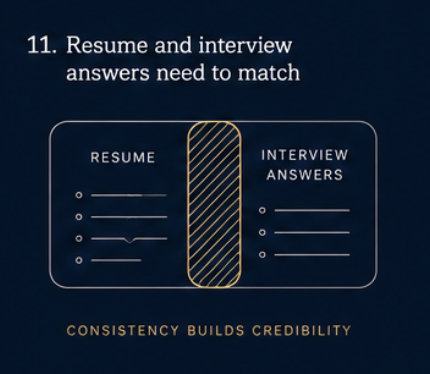
How your resume and your interview answers need to match
The fastest red flag in an interview isn’t a bad answer. It’s when your interview answer doesn’t match your resume.
Most candidates don’t realize this is happening to them. You wrote your resume eighteen months ago. You’ve told the story of that project a dozen times since then. Each time you tell it, you emphasize different parts depending on the audience. By the time you walk into your next interview, the story you’ll tell out loud has drifted away from the bullet point on the page.
The interviewer is reading the bullet point. They’re listening to the story. They’re checking the match.
When the two don’t line up, the interviewer doesn’t say anything — they just quietly mark you down.
The “same project, different focus” problem
Here’s the most common version. Your resume bullet says:
“Led cross-functional team of 6 to launch new pricing model, resulting in 18% increase in ARPU within Q3 2024.”
And in the interview, you say:
“Yeah, that pricing model was a team effort. I worked closely with finance to model the impact and with sales to handle objections from existing customers. It was a really collaborative experience.”
Spot the problem?
Resume says you led. Interview answer says you collaborated. Resume claims the outcome was 18% ARPU lift. Interview answer doesn’t mention any outcome at all.
The interviewer is now wondering which version is true. And whichever version they decide to believe, you’ve lost credibility on the other one.
The pre-interview audit
Spend 30 minutes before any interview doing this:
Print your resume. Yes, on paper. Reading on paper makes you notice things screen-reading misses.
Read it out loud, bullet by bullet. For each bullet, ask yourself: if the interviewer asked me to talk about this for two minutes, what story would I tell?
Write down the story. Not in full — just three lines. The stakes, what you did, what changed.
Compare your story to the bullet. Does the verb match? Does the scale match? Does the outcome match? If the bullet says “led” and your story sounds like collaboration, one of them needs to change.
The fix is almost always to update the bullet. Your real story is what you’ll naturally say out loud. The resume bullet was written to sound impressive on paper, but if you can’t back it up in the interview, it’s working against you.
How interviewers test for consistency without telling you
Three common tests:
The verb check. An interviewer will read a bullet point and ask “tell me more about how you led that.” If your answer doesn’t include specific leadership behaviors — assigning work, making the calls, having the hard conversations — they know you didn’t actually lead it.
The number check. If your resume claims a percentage or dollar figure, expect a follow-up: “How did you measure that? Where did you get that number?” If you don’t know, the number reads as fabricated even if it isn’t.
The team check. Senior interviewers ask “who was on the team, and what did each person do?” If you can’t name the team or their roles, the project starts to sound theoretical instead of real.
Quick fixes for common mismatches
If your bullet over-claims: Update the verb. “Led” becomes “collaborated on.” “Built” becomes “contributed to.” Lower the claim to match the truth.
If your bullet is too generic: Add the specific number, person, or moment that you’d mention in the interview. If you’d say “we cut deployment time from 4 hours to 30 minutes” in the room, that should be on the page.
If your bullet emphasizes the wrong outcome: If you’re proud of the team-building aspect of a project but your resume only mentions the financial outcome, your interview will emphasize the team and your bullet will emphasize the money. Pick one and align both around it.
The forgotten case: roles you’ve been in too long
Most candidates audit recent roles. They forget older ones.
If you’ve been at your current company for four years, you’ve forgotten what was in the bullets you wrote about your first role there. The interviewer will ask about it because it’s on the resume. If the answer feels rusty, the interviewer wonders whether you’re inflating your earlier work.
Re-read every bullet on your resume, no matter how old. If you can’t tell a coherent two-minute story about each one, that bullet shouldn’t be on the resume anymore.
Try this
Take your three most recent resume bullets. For each one, write a single sentence answering: What would I say out loud if the interviewer asked me to talk about this?
Then check: does the sentence match the bullet’s verb, scale, and outcome? If not, you have two choices — change the bullet or change the story. The story is usually closer to the truth.
If your resume and your interview answers feel like they’re telling different versions of the same project, that’s worth fixing before the next round. I do this kind of alignment work in the combined Resume + Interview package.
More on that: resume and interview coaching. Free 15-minute consult: book here. Free 25-questions guide: download here.
Free guide
The 25 interview questions you must prepare.
The starter list I use with every coaching client. Finance, consulting, tech, MBA, medical, residency. Different industries, same underlying questions.
Or book a free 15-minute consultation with Neil.