Why you’re getting interviews but not offers
If you’ve been interviewing for two or three months and you keep getting to the final round only to hear “we went with another candidate” — you’re not unusual. You’re not unqualified. And you’re not unlucky.
You’re stuck in the most diagnosable pattern in job searching, and almost nobody talks about it honestly.
Here’s what’s actually happening.
The pattern
You’re getting first rounds. Sometimes seconds. Occasionally finals. The interviewers are friendly. The conversations feel like they go well. You walk out thinking you might have it.
Then you get the rejection. Usually polite. Sometimes vague. Often something like “we really enjoyed meeting with you, but we’ve decided to move forward with another candidate” or “your background was strong but it wasn’t quite the right fit.”
You read the email twice and you have no idea what it means.
The good news, before anything else: if you’re getting first-round interviews consistently, your resume is doing its job. Your background is hitting the bar. Companies want to talk to you. The breakdown is happening inside the interview, not on paper.
That’s actually the easier problem to solve.
The four reasons it’s happening
After 15 years of coaching candidates through this exact pattern, almost every case I see comes down to one or more of four things.
1. Your stories aren’t landing
You have real experience. You know the work cold. But when an interviewer asks “tell me about a time you led a difficult project,” what comes out of your mouth is some version of:
“So in my last role we had a project that was kind of stuck and I worked with the team to figure out how to get it unstuck and we eventually got it done…”
That answer is technically responsive. It’s also forgettable.
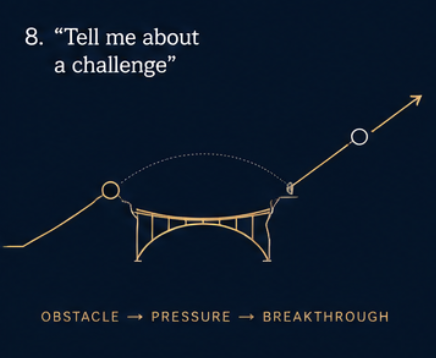
The candidates who get offers have 4 or 5 specific, sharp stories they can flex into any behavioral question. They open with the stakes — the thing that was actually on the line. They name the friction — the thing that made it hard. They describe what they specifically did, not what “we” did. And they end with what changed, including the second-order effect that came later.
The interviewer doesn’t remember your project. They remember the texture of the story. If the texture is generic, you blend into 50 other candidates.
2. You’re rambling under pressure
You knew the answer before you walked in. The interviewer asked the question, and you spoke for three minutes when 60 seconds would’ve nailed it.
Why this happens: anxiety. When you’re nervous, the brain reaches for length as a hedge against being wrong. The instinct is “I don’t know if this is what they want, so I’ll cover more ground.” It’s the opposite of what works.
Interviewers stop listening at the 90-second mark on any one answer. After that, you’re not adding value — you’re using up the goodwill you built in the first sentence. If you’ve been told you “talk too much” or you walk out of interviews feeling like you over-explained, this is probably your bottleneck.
3. Your “why you, why this firm” answers are generic
This is the question every interviewer asks and most candidates blow.
The bad versions you’ve probably said yourself: “Your firm is a leader in the industry and I’d love to learn from the best.” “I want to grow my career and you have great opportunities.” “I’m passionate about this space.”
The interviewer doesn’t hear answers. They hear flattery, growth-talk, and passion-talk. All of which read as you don’t actually know much about us yet.
The candidates who get offers spent two hours preparing the “why this firm” answer. They can name a specific deal the firm closed, a specific team member’s writing, or a specific decision the firm made. They connect it back to something specific about themselves. That research is what wins the offer.
4. The energy gap
You walk in tired. You’ve done five interviews this week. You’re slightly demoralized because the last one didn’t work out. The interviewer asks a softball question and you give a serviceable answer in a flat tone.
The interviewer doesn’t think “this person is exhausted.” They think “this person doesn’t really want this job.”
The energy gap is real. Hiring managers consciously or unconsciously screen for enthusiasm — not performed enthusiasm, just visible engagement. If your voice is monotone, if your face is neutral, if you’re answering questions correctly but without any spark, you’re losing offers to candidates who are technically less qualified but visibly more excited.
How to figure out which one is yours
It’s usually one dominant reason and one or two secondary ones. The fastest diagnostic:
If you can’t remember what you said in your last interview within an hour of walking out → it’s probably the stories problem. Generic answers don’t stay with you because they don’t stay with anyone.
If you finish answers and immediately think “I should have just stopped at this point” → it’s probably the rambling problem.
If your “why this firm” answer is the same paragraph with the company name swapped → it’s probably the positioning problem.
If you’ve gotten feedback like “they liked you but didn’t think you really wanted it” → it’s the energy gap.
Sometimes it’s two of these at once. That’s still a fixable problem.
What to do this week
Pick the most dominant problem. Don’t try to fix all four at once.
If stories are the issue: rebuild your top 4 behavioral stories. For each one, write three sentences. The stakes. What you specifically did. What changed afterward. Read each one out loud. If it sounds like a person talking, you’re closer.
If rambling is the issue: set a 90-second timer when you practice. Force yourself to land the answer before it goes off. Your first 10 attempts will feel rushed. By number 20, they won’t.
If positioning is the issue: spend two hours on the next firm you’re interviewing at. Find one deal, one team member’s writing, or one decision you can cite specifically. Build the “why this firm” answer around that, not around their About page.
If energy is the issue: 20 minutes before any interview, do something that physically wakes you up. Walk briskly outside. Have a short, specific conversation with someone you like. Get your voice into a higher register. You’re not faking enthusiasm — you’re putting yourself into the energy state you’d have if you were already excited about the role.
The bigger point
You don’t have an experience problem. You have a translation problem. Your experience is in your head. The interviewer can only see what you say out loud, in the room, in the time allotted.
Most candidates assume that the interview is a check on whether you’re qualified. It isn’t. It’s a check on whether you can communicate that you’re qualified. Those are two different skills, and the second one is fixable in 3 to 5 focused sessions.
If you’re tired of “we went with another candidate” and you want to figure out which of the four is your real problem, free 15-minute consult: book here. I’ll tell you within five minutes.
More on this exact pattern: Getting interviews but not offers. Free 25-questions guide: download here.
Free guide
The 25 interview questions you must prepare.
The starter list I use with every coaching client. Finance, consulting, tech, MBA, medical, residency. Different industries, same underlying questions.
Or book a free 15-minute consultation with Neil.