“Tell me about yourself” — the answer that actually works
There’s a 30-second window at the start of every interview where you either earn the next 25 minutes or hand them to the next candidate. It opens with the same four words, every time.
“Tell me about yourself.”
Most candidates blow it.
Not because they don’t know what to say. Because they say the wrong thing. Here’s the version I hear most often when I run mock interviews:
“Sure. I grew up in [city], went to [school], graduated in [year] with a degree in [major]. I started at [first company] doing [role]. Then I moved to [second company] where I’m currently a [title]. I’m looking for something new because I want to grow my career.”
Every word is true. The interviewer wants to take a nap.
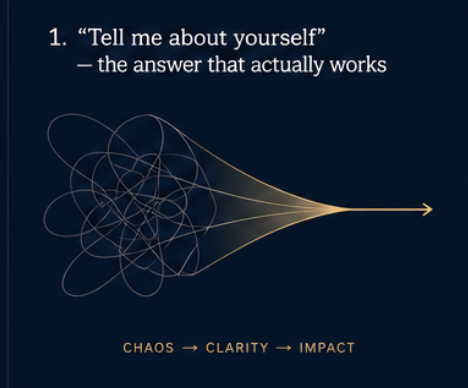
The problem is structural. The candidate gave the interviewer their LinkedIn profile, read out loud. The interviewer already has the LinkedIn profile. What they actually want — what they’re really asking when they say “tell me about yourself” — is a signal that you understand how your story connects to this job.
The three-sentence answer
Sixty to ninety seconds total. No more.
Sentence one — where you’ve been. One sentence that frames you in a specific way. Not “I started at X.” Something like “I’ve spent the last six years building underwriting models for credit funds” or “I’ve been a product manager focused on B2B SaaS at companies scaling from 50 to 500 people.”
The verb matters. Don’t say “worked at” or “had a role at.” Say what you actually did. Building, leading, shipping, designing, structuring, advising.
Sentence two — what you do now and why it matters. A specific moment in your current work. Not “I’m a senior analyst.” Try “Right now I run our quarterly investment review process for a $400M energy portfolio, which has taught me how to defend investment theses in front of skeptical partners.”
The title doesn’t matter. The work does. What skill did it build? What problem did it solve?
Sentence three — why you’re here. This is the sentence everyone skips. Not “I’m looking for new opportunities.” That tells them nothing. Try: “I’m looking for the next stage of my career to be at a firm where the work scales — and your team’s been building exactly that kind of platform.”
End there. Don’t ramble. Don’t keep talking to fill the silence.
Why this works
Three reasons.
It forces specificity. Generic answers get generic responses. “I’m passionate about helping people” produces “thank you, next question.” Specific answers produce follow-ups. Follow-ups are where you actually demonstrate value.
It controls the agenda. When you say “I run our quarterly investment review process,” you’ve handed the interviewer a thread to pull. They will. Now you’re talking about your strongest work for the next ten minutes — instead of answering whatever random question they were going to ask next.
It ends with intent. That third sentence is a soft commitment to why this job. It signals you’ve thought about it. Hiring managers can tell the difference between candidates who want a job and candidates who want this job. The third sentence is where you prove which one you are.
What not to do
A few patterns I see every week.
Don’t start with where you grew up. Unless your hometown is somehow relevant to the role, it burns 15 seconds of an answer that should run 60.
Don’t list every role chronologically. You’re not reciting your CV. Pick one or two threads.
Don’t end with “…and that’s me!” or “…so yeah, that’s a bit about me.” It deflates the answer. End on the sentence about why you’re here. That’s the strong note.
Don’t go past 90 seconds. I’ve coached candidates whose “tell me about yourself” answer ran four minutes. The interviewer disengaged at 90 and never recovered.
Try this now
Five minutes. Write three sentences:
- One sentence about what you’ve done. Use an active verb.
- One sentence about what you do now. Describe the work, not the title.
- One sentence about why you’re talking to this specific company. Don’t say “looking for new opportunities.”
Read it out loud. If it sounds like a person talking, you’re done. If it sounds like a press release, rewrite.
If you want help building the version that lands for your specific situation — not a template, the actual answer using your real stories — that’s what I do for a living. Free 15-minute consult: book here.
The full list of questions to prep before your next interview: download the free 25-questions guide.
Free guide
The 25 interview questions you must prepare.
The starter list I use with every coaching client. Finance, consulting, tech, MBA, medical, residency. Different industries, same underlying questions.
Or book a free 15-minute consultation with Neil.