How to answer “Walk me through your resume” in a finance interview
Walk me through your resume is the most underrated question in finance interviews. Candidates assume it’s a chronology question. It’s not. It’s a “explain your career decisions” question. And the people who answer it badly are the ones who got the loudest “no” thirty minutes later, even though the rest of the interview went fine.
Here’s what’s actually being asked and how to answer it.
What the interviewer wants to hear
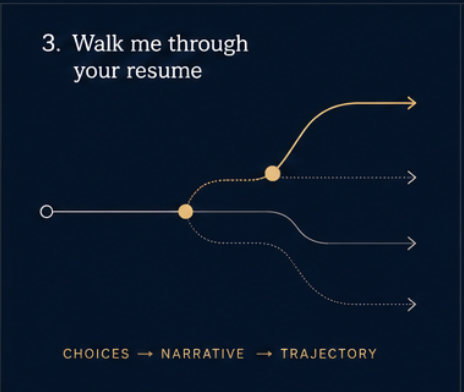
The first 60 seconds set the tone. The interviewer has read your resume — they don’t need you to read it back. What they want is to hear why each transition happened. Not what you did, but why you moved from undergrad to that first job. Why you stayed at the second one for three years instead of two. Why you’re talking to them now.
Three reasons matter:
It signals judgment. Someone who can articulate why they took a job demonstrates that they make career decisions deliberately. Someone who can only narrate “I worked at X, then Y” sounds like they drifted into roles.
It surfaces values. A candidate who says “I left X because the work was too transactional and I wanted more structured analysis” is telling you what they care about. The interviewer can match that against the role they’re filling.
It tests fit indirectly. If your “why” answers consistently emphasize team culture and mentorship, but you’re applying to a sharp-elbowed prop shop, that’s a flag. The “walk me through your resume” answer is where that compatibility either lands or doesn’t.
The structure
Two minutes maximum. Allocate time inversely to age — spend less on early stuff, more on current role.
Undergrad — 15 seconds. “I studied [major] at [school] because [one sentence on why, related to where you ended up].” Don’t list GPA. Don’t list activities unless one of them shaped your career.
First role — 20 seconds. “I started at [firm] doing [role]. I took it because [the decision].” Then the lesson: “It taught me [the specific skill or insight].”
Each subsequent role — 30 seconds. Same template. The reason for leaving and the reason for joining the next place. Don’t apologize for transitions — own them.
Current role — 45 seconds. Most of the airtime goes here. What you do, the most specific recent project, and one concrete thing it taught you.
The pivot to “and that’s why I’m here” — 10 seconds. End on intent. “Which is why I’m interviewing for this role — your team is the next obvious step because [reason that ties to your last sentence].”
What kills the answer
Three common failures:
Reciting the resume. “I was an analyst at Goldman from 2018 to 2020, then an associate at Apollo from 2020 to 2023, currently at…” The interviewer has the resume. Skip to why.
Apologizing for gaps or moves. “I know I’ve changed roles a few times…” Stop. Don’t preempt criticism that hasn’t been made. Just explain each move on its own merits.
Going past two minutes. I’ve watched candidates spend six minutes on this question. By minute four, the interviewer has stopped listening and started thinking about lunch.
Example: a candidate going for a private equity associate role
“I studied economics at Penn because I wanted to do macroeconomic research before I knew finance existed.
Senior year I interned at Goldman in M&A — I joined because the work was concrete and the team had a reputation for actually teaching juniors. Two years there taught me how to build a model that holds up under partner-level scrutiny.
I moved to Apollo in 2021 because I wanted to see how the same companies look from the buy-side. The first deal I worked on was a $2B carve-out from a healthcare conglomerate, and the difference between modeling for advisory and modeling for ownership was the most important learning of my career — you stop being right and start being responsible.
Right now I’m leading underwriting on our energy transition vertical. The most recent deal I closed was a $400M minority position in a battery storage developer. I built the LBO from scratch and presented it to the IC.
Which is why I’m interviewing for your firm — your team has been building out the same vertical with a more concentrated thesis, and the work I want to do for the next five years is exactly what you’re scaling.”
That’s two minutes. Notice what’s NOT there: dates, GPA, university honors, list of every deal. Just the decisions, the lessons, and the connection to this seat.
Try this
Take your resume. Pick three roles. For each one, write a single sentence answering: Why did I take this job, and why did I leave?
If you can’t answer either question without using the words “opportunity” or “growth,” your answer is too generic. Be specific. The specificity is what gets the offer.
If you have a finance interview coming up and you want to pressure-test your resume narrative before the real thing, free 15-minute consult: book here.
More on the finance prep track: finance interview coaching. Free 25-questions guide: download here.
Free guide
The 25 interview questions you must prepare.
The starter list I use with every coaching client. Finance, consulting, tech, MBA, medical, residency. Different industries, same underlying questions.
Or book a free 15-minute consultation with Neil.