MMI Interview Questions and Answers: A Coach Guide with Sample Responses
Medical School Interview Prep
The Multiple Mini Interview is not a test of memorization. It is a test of how you think, how you weigh competing values, and how you communicate under pressure. This guide walks through the question types that show up most often, sample answers with the reasoning behind them, and the mistakes that quietly cost applicants an offer.
What the MMI actually measures
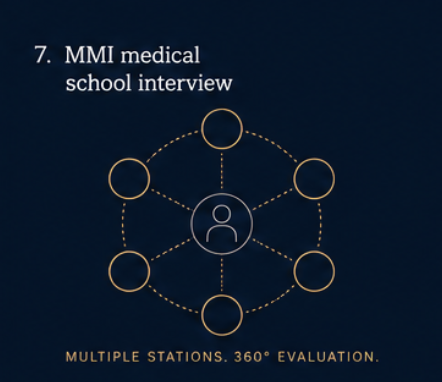
Admissions committees use the MMI to see behaviors that traditional interviews miss. Each 6 to 10-minute station is scored by a different rater, which means one weak station does not sink your entire day, and one memorized answer will not carry you through.
The seven attributes MMI stations typically test:
- Ethical reasoning and moral judgment
- Communication and active listening
- Empathy and cultural humility
- Critical thinking under uncertainty
- Teamwork and conflict resolution
- Self-awareness and professionalism
- Advocacy and health-systems understanding
You are not being asked for the right answer. You are being asked to show that you can hold two competing values in your head, explain the tradeoff, and land on a position without pretending the tradeoff was easy.
The seven MMI question types with sample answers
1. Ethical scenario stations
You are given a situation with two defensible actions. The question is not which one you pick. It is how you reason through both.
Sample opening: There are two obligations pulling against each other here. My obligation to my friend, and my obligation to the profession I am trying to enter. I want to think through both before I decide.
What makes this work: you name the tension out loud. You do not rush to a verdict. Then walk through the friend welfare (she may be under pressure you do not understand), the integrity of the profession (a career that requires trust starts here), and options that respect both (encourage her to self-report, offer to go with her, escalate only if she refuses). Close by naming what you would actually do and why.
What kills the answer: picking a side in the first sentence, moralizing, or pretending there is a clean choice.
2. Situational judgment stations
You are given a clinical or interpersonal scenario. The rater wants to see how you gather information before acting.
Strong answer structure: start by naming what you do not know (why she is refusing, what her values are, whether she is decisionally capacitated). Then walk through the conversation you would have with the patient first, alone, in language she can understand. Then how you would bring the family in without ambushing the patient. End with the ethical principle you are protecting (autonomy) and what you would do if her capacity were in question.
Raters are looking for: information-gathering first, respect for autonomy, humility about the family fear, and a plan that does not treat the patient as a decision to be won.
3. Role-play or acting stations
You interact with a standardized actor. The scenario often involves delivering difficult news, handling an upset patient, or resolving a conflict.
Rules that matter more than the words:
- Sit down. Match their energy. Do not stand over them.
- Ask before you tell. What have you already been told? is often the first correct sentence.
- Use short sentences during hard news. Long paragraphs read as scripted.
- Silence is a tool. Let them react before you fill the space.
- Reflect what you hear before you problem-solve.
Coach note
The most common mistake in role-play is trying to sound like a doctor. Sound like a human who is also going to become a doctor. The actor is scoring you on presence, not vocabulary.
4. Traditional behavioral stations
These look like a regular interview question dropped into the MMI: Tell me about a time you failed, or Why medicine?
Answer them with the same structure you use in any behavioral: brief context, specific action, concrete result, and one sentence of insight about what it taught you. Keep it to 90 seconds. MMI raters have less patience than traditional interviewers because they know a full-length answer eats their scoring window.
5. Policy and health-systems stations
These stations reward candidates who can hold both sides before landing. Start with what each side is actually protecting. Physicians who strike are usually protecting patient care conditions or their ability to advocate for the vulnerable. Physicians who oppose striking are usually protecting the individual patient in front of them today. Then take a position, name what you are choosing to prioritize, and acknowledge what you are giving up by taking that position.
You do not need to be right. You need to be reasoned.
6. Why medicine and personal stations
The rater has read your file. Do not repeat it. Use the station to add a story or a lens that is not on your application.
Weak answer: I have wanted to be a doctor since I was young because I love science and helping people.
Stronger: The moment I stopped thinking about medicine as a career and started thinking about it as an obligation was during my second summer at a hospital placement. I saw a resident sit for 20 minutes with a patient whose English was not strong, walking through his discharge paperwork line by line, and it was the first time I understood that the actual work is often that small and that patient.
7. Prioritization and teamwork stations
You get a scenario with too many things to do and not enough time. The rater wants to see your reasoning: what you prioritize, what you delegate, what you drop, and why. Walk through your logic out loud. The wrong answer is silence while you try to figure it out.
The 5 mistakes that quietly sink MMI stations
- Answering before you understand the prompt. Take 15 seconds. Repeat back the question in your own words if you need to.
- Refusing to take a position. Considering both sides is required. Refusing to land is not.
- Sounding rehearsed on personal stations. Raters can hear a script. Trust the specifics of your own story.
- Rushing to fill silence. Especially in role-play. Presence beats performance.
- Forgetting the two minutes to read the prompt. Use them. Outline three points on your scratch paper before the timer starts.
How to actually prepare
Reading question banks is not preparation. You have to say the answers out loud, ideally with someone who will interrupt you and ask follow-ups. Practice with a mirror or a phone recording for two weeks, then move to live practice with someone who has done this before.
A realistic prep timeline for candidates 6 to 8 weeks out:
- Weeks 1 to 2: Read one prompt per day, outline your answer, record yourself, listen back.
- Weeks 3 to 4: Two prompts per day, timed. Get comfortable with the 2-minute read plus 6-minute response cadence.
- Weeks 5 to 6: Full mock circuits with a coach or study group. Focus on the role-play and ethical stations, which are hardest to self-diagnose.
- Week 7: Rest. Do two or three light stations. Sleep.
Want a mock MMI with real feedback?
One-on-one MMI coaching includes ethics stations, role-play with feedback, and a mock circuit two weeks before your interview. First session refundable if it is not a fit.
Book a free 15-minute call