“Why MBA?” — what HBS, Stanford, and Wharton are actually asking
The “why MBA” question kills more candidates than any other question in business school admissions.
It’s the question every MBA program asks, almost always in the first or second interview slot, and 90% of candidates blow it by treating it like a question about graduate school. It isn’t.
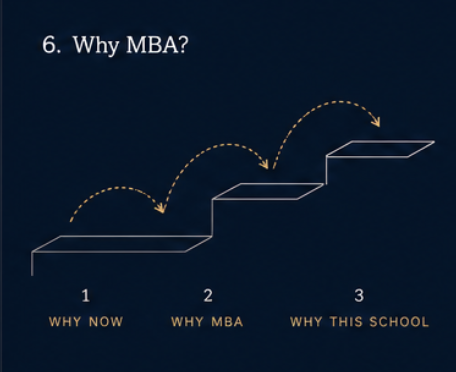
It’s three questions stacked into one.
- Why this stage of your career?
- Why business school specifically, instead of the obvious alternatives?
- Why this program — and not the four other top programs you’re also applying to?
The candidates who get in are the ones who answer all three. Most candidates answer one.
Why “I want to pivot careers” doesn’t work
The most common bad answer is some version of “I’m pivoting from [industry A] to [industry B] and an MBA will help me get there.”
This answer fails for three reasons.
It’s about you, not them. The admissions committee isn’t trying to staff a transition agency. They’re trying to fill a class with people who’ll contribute to their community and represent the school well.
It implies they’re a means to an end. “An MBA will help me get there” makes the school a credential, not a destination. Adcoms can smell this.
It doesn’t differentiate. Half the class is pivoting careers. “Pivot” is table stakes, not a story.
The three-layer answer
Layer 1 — Why now. Why is this the moment in your career? Not “I’ve hit a ceiling” — that’s reactive. Something forward-looking: “I’ve spent five years in [role] and I’ve taken it as far as the role itself lets me. The next chapter requires a skill set I don’t have yet — [name the specific one].”
The specificity is what does the work. “I want to grow” is generic. “I want to learn how to lead a P&L across multiple functions, which I can’t do in my current operator role” is concrete.
Layer 2 — Why business school, not the alternatives. The committee already knows that an MBA is one path. They want to see that you’ve considered the others and chose this one deliberately.
Mention the alternatives explicitly: “I considered a startup, a lateral move into [adjacent field], an executive program. The reason I chose a full MBA is [reason specific to your situation].” Common reasons that work: needing the network, needing time away from current operating context, needing a structured cross-functional curriculum, wanting access to a recruiting pipeline that doesn’t exist otherwise.
Layer 3 — Why this program. This is where most candidates default to flattery. “Stanford has the strongest culture of innovation.” Generic. Doesn’t sound researched.
The version that lands is specific. “I’ve been following [specific professor’s] work on [specific topic] — their 2024 paper on [thing] is one of the reasons I want to study at GSB. I’ve also talked to three current students in the [specific club or program] and what they described isn’t replicated at the other programs I’m applying to.”
Name the names. Name the program. Name the conversation.
What HBS, Stanford, and Wharton each actually look for
Each program has a different bias, even though the question is the same.
HBS — leadership at scale. The “why MBA” answer that works for HBS connects your career story to a moment where you led people through ambiguity. Even if you’re a 27-year-old analyst, you need one story where you were the one making the call. HBS doesn’t admit followers.
Stanford GSB — clarity of intent and intellectual ambition. The Stanford answer is more reflective. They want to hear that you’ve thought about what you want to do at a level deeper than “growth.” There’s a reason their essay prompt is “what matters most to you, and why” — they’re filtering for self-awareness.
Wharton — substantive analytical ambition. Wharton candidates need to be more specific about the content of what they want to learn. The most successful Wharton “why MBA” answers I’ve coached have included specific course numbers, specific professors, and specific clubs.
You can recycle 60% of the answer across programs. The remaining 40% — the “why this program” — has to be re-built for each school.
What to skip
- Don’t list jobs you want post-MBA. The career goal matters less than the reasoning about how the MBA gets you there.
- Don’t mention specific firms you want to work at unless asked. “I want to do consulting at McKinsey” reads like a credential-chase.
- Don’t apologize for being older or younger than the average. The committee already knows.
Try this
Write three sentences. One for each layer:
- Why this stage of my career, specifically.
- Why business school, specifically — and what I considered instead.
- Why this program, specifically — with one detail no other applicant would mention.
Read them out loud. If sentence three sounds like a review of the school, rewrite.
If you’re applying to HBS, Stanford, Wharton, Booth, Kellogg, or any top-tier MBA program and you want to pressure-test your “why MBA” answer with someone who’s coached candidates through these specific interviews, free 15-minute consult: book here.
More on MBA admissions: MBA interview prep. Free 25-questions guide: download here.
Free guide
The 25 interview questions you must prepare.
The starter list I use with every coaching client. Finance, consulting, tech, MBA, medical, residency. Different industries, same underlying questions.
Or book a free 15-minute consultation with Neil.